


Why India VC Is Entering a More Institutional Decade
A decade ago, India’s venture conversation was dominated by the question: could the country produce enough large technology companies to justify the capital flowing in? At VC101, the question has shifted. India now has the founders, the exits, the domestic capital pools, and the public-market appetite to make venture capital a more durable asset class. The harder question is whether enough fund managers can build enduring venture firms around that opportunity.
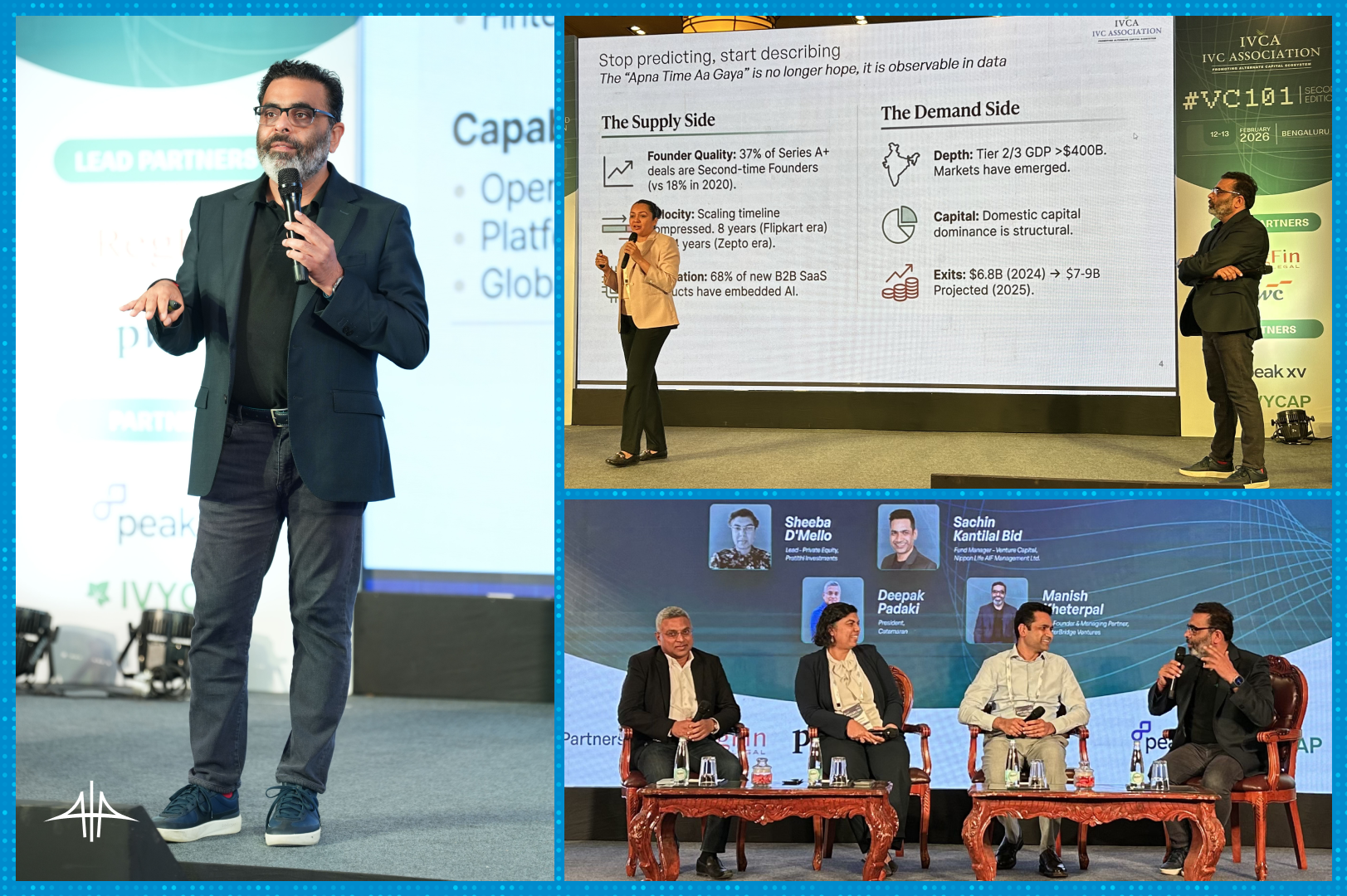
IVCA’s VC101 is poised to be an institutional training layer for the next generation of venture fund managers, covering macro context, fund structuring, LP engagement, investment process, governance, exits, returns, and reporting. Manish Kheterpal, Co-founder and Partner at WaterBridge Ventures, was part of the Mumbai edition, where the conversation centred on the global VC landscape, fund strategy, and investment process. In Bengaluru, Manish and Anjali Sosale decoded the global and Indian VC/PE landscape for the second edition, bringing WaterBridge’s vantage point as an early-stage firm that writes the first cheque and stays with companies across the arc.
The signal from the sessions was clear: India’s venture market is becoming more mature, but also more demanding.
One of the strongest data points was the rise of the repeat founder. In 2025, 37% of Series A+ investments went to companies founded by 2X entrepreneurs. In 2020, that number was only 18%. This is a meaningful shift in the founder base. India is no longer only a first-time founder market. It now has exited founders, second-time operators, and tenured leaders who understand hiring, capital, regulation, product-market fit, and the cost of scaling too quickly.
Repeat founders change the shape of risk. They may still fail, but they often fail differently. They know which mistakes consume time, which hires matter early, which metrics are vanity, and when to raise capital. For fund managers, this creates a new access challenge. The best repeat founders do not need every investor. They choose partners who can understand the company before consensus forms.
Scaling timelines are compressing too. The contrast is stark between Flipkart’s arc and that of Zepto. Whether every company can or should scale faster is a separate question. The broader point is that India’s best startups are reaching national scale, institutional funding rounds, and public-market imagination faster than earlier cohorts did. That compression creates excitement, but it also leaves less time for governance, finance discipline, culture, and operating systems to mature quietly in the background.
The public markets are now a real part of the VC equation. India remained one of the world’s most active IPO markets by deal count in 2025, and FY 2025-26 saw a record number of IPO listings, with PE-backed listings rising as a share of issuances. For venture firms, this changes the conversation from markup to realisation. DPI is no longer a theoretical endpoint at the end of a fund presentation. It is becoming a visible proof layer.
DPI matters because it does more than return money. It restores LP confidence, lets managers raise with evidence rather than only narrative, and recycles capital back into the ecosystem. Exited founders become angels. Operators become founders. LPs become more comfortable backing managers through cycles. Funds that have delivered liquidity can underwrite the next cohort with a different kind of credibility.
But DPI is uneven. It will not automatically flow to every fund simply because India’s market is growing. Public-market depth helps, but exit timing, entry price, ownership, reserve strategy, and portfolio construction still decide outcomes. A good market can hide weak discipline for a while. It rarely protects it across vintages.
That is the caution embedded inside the Goldilocks argument. India currently offers a compelling growth-stability mix. Public markets are deeper. Domestic institutions are more active. Repeat founders are stronger. Large public programmes are expanding the capital stack: the RDI Scheme, Startup India Fund of Funds 2.0, BIRAC-RDI, and IndiaAI Mission together signal that patient capital for research, deep tech, manufacturing, AI, and early-growth startups is becoming more abundant.
Yet more capital does not automatically create better venture outcomes. It creates the possibility of better outcomes. Fund vintage and manager selection still matter.
Global VC history is useful here. Venture capital can outperform over long windows, but performance is highly sensitive to cycle, vintage, entry price, and manager quality. The 2016-21 period benefited from cheap capital, expanding multiples, and strong technology adoption. The 2022-24 period forced a reset around valuations, liquidity, and distributions. McKinsey’s private-markets review captured that reversal globally: VC had outperformed buyouts in seven of the ten years before 2022, but buyouts then outperformed VC for seven consecutive quarters through September 2023.
For emerging managers, that is the lesson VC101 is built to teach. Fund management is not simply the ability to spot promising startups. It is the craft of building an institution: raising the right capital, setting the right fund size, entering at prices that can return the fund, reserving for winners, supporting governance, managing LP trust, reporting honestly, and knowing when to distribute.
India’s next venture decade will therefore be shaped by two loops running together.
The first is the founder loop: repeat founders, faster scaling, better operators, deeper public markets, and more capital recycling into the next generation of companies.
The second is the fund-manager loop: better portfolio construction, more disciplined underwriting, stronger LP communication, sharper exit planning, and higher expectations around DPI.
VC101 sits at the intersection of those loops. India’s startup market is entering a stronger decade, but the capital behind it must mature at the same pace. The country does not only need more venture money. It needs better venture institutions.
India is not risk-free. No venture market is. Liquidity cycles can tighten. Public markets can become selective. Repeat founders can be overfunded. Domestic capital can be misallocated. New managers can confuse momentum with skill.
But the ingredients are stronger than they were a decade ago. India has more experienced founders, more visible exits, more domestic capital, and a public market capable of absorbing technology companies. That combination gives Indian VC a rare window. The firms that turn that window into returns will be the ones that treat venture capital as a craft, not a sentiment.
The best decade for Indian venture may well be ahead. VC101’s message is that it will belong to managers who can convert the opportunity into discipline, and discipline into DPI.