

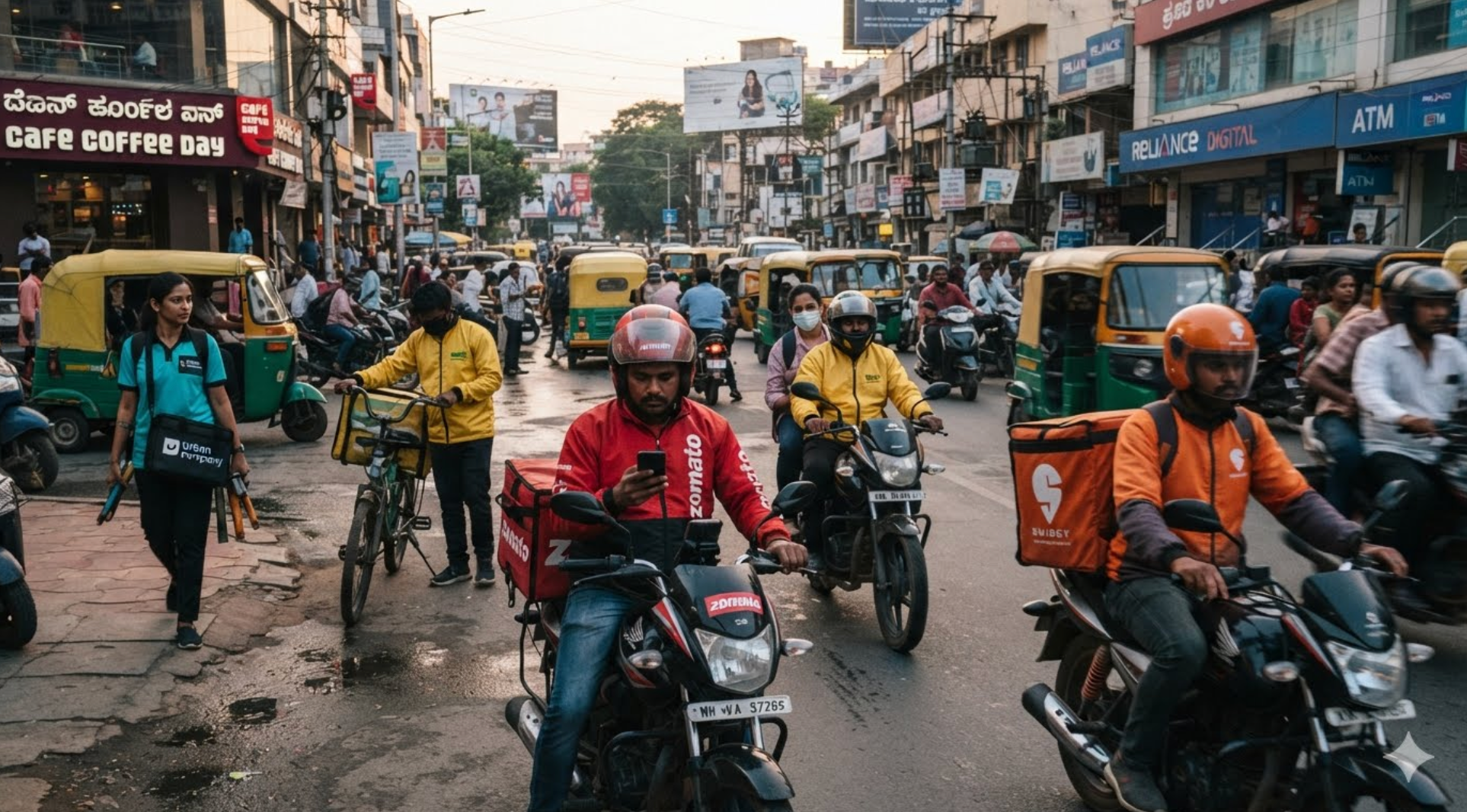
Swiggy and Zomato each engage ~450K delivery partners monthly.
In fact, 20-30% of India's gig workers are engaged in hyperlocal and e-commerce deliveries. The gig economy has transformed the way Indians work, move and live. From ride-sharing (Ola/ BluSmart), to household services (UC) to freelance digital work (Upwork, Freelancer), various sectors contribute to our burgeoning gig economy.
🌐 Snapshot of the Gig Landscape
Out of India's ~550M workforce, about 8M (< 2%) are gig workers. This figure is projected to 3x to 24M in 3-4 years and 11x to 90M in 8-10 years.
Comparatively, China has 200M gig workers which comprise about 27% of China's ~734M workforce. Undoubtedly, India's gig workforce is set to explode in the coming decade.
🚴♂️ State of the gig workers in India:
The gig economy extends beyond just tier-1 or metropolitan areas, which represent only 35% of the gig workforce. There has also been a significant increase in demand for gig work in tier-2 and tier-3 cities.
Urban gig workers involved in hyperlocal deliveries typically earn between ₹15,000 and ₹20,000 ($188 to $250) per month, or $3K p.a.
At WaterBridge, we estimate that about 206M households today are earning less than $6K p.a. Given that gig economy offers a fairer and more structured alternative to instability and income insecurity, there is ample room for this tier to grow.
💡 Platforms enabling Gig Economy: Hard To Scale?
While numerous startups have aimed to address the challenges of human resource management functions in gig, only a handful of startups such as job search platforms like Apna and Goodworker, work fulfillment platforms like Awign, to high-velocity discovery platforms like WorkIndia and Vahan, have seen some success.
Many players who have tried building blue-collar worker marketplaces have struggled to achieve PMF (either acqui-hired/ shut-down). Platforms for freelancers and small tasks hasn't seen much success either.
📈 What's Next?
There's over 25%+ attrition rates today in the gig sector. At a platform level, the value chain of the gig economy (discovery to matchmaking, training, upskilling, retention and replacement) continues to have missing pieces.
Multiple verticalised models are starting to emerge (eg. Wishlink democratizing influencer marketing). There's further scope for startups to build platforms enabling services for gig workers (eg. insurance).
At a category level, while hyperlocal delivery (e-commerce/ q-commerce), personal and at-home services, have seen significant success, it'll be interesting to witness which new sectors can be built upon India's flourishing gig economy.
While some startups in categories like laundromats and at-home chefs have already tried and burnt their hand, others like petcare found some success eg. Wag! in the US popularised its on-demand dog-walking service ($84M revenue).