

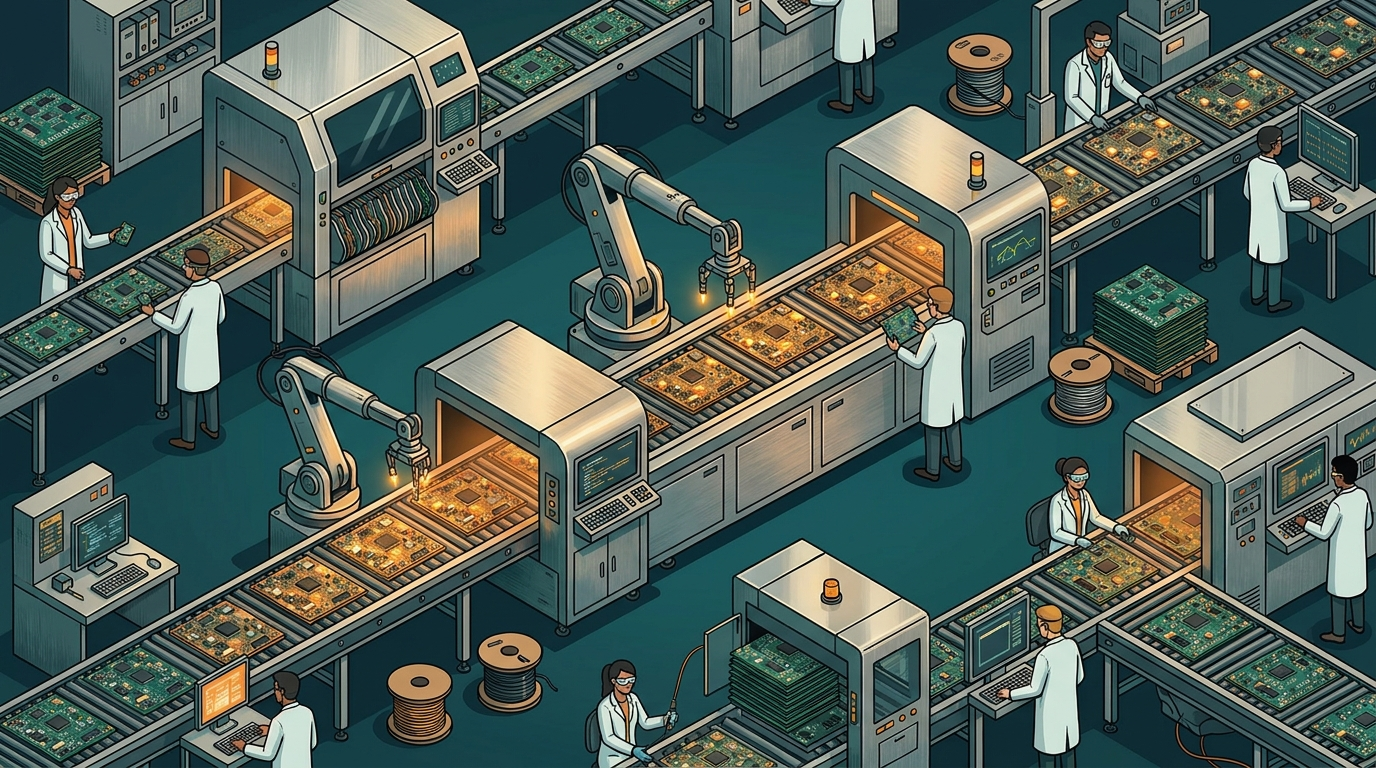

India’s EMS (Electronics Manufacturing Services) sector has entered a decisive inflection point. Over a richly synergistic window between 2025 to 2030, early-stage capital has a rare chance to establish enduring franchises
Small Parts, Big Opportunity
Late one evening in Bengaluru, a hardware startup founder watches a gleaming new SMT assembly line churn out circuit boards. A decade ago, he might have sourced these boards from China – but today they’re being made right here in India. Meanwhile, in a Chennai industrial park, one of Apple’s largest contract manufacturers is ramping up production of “Made in India” iPhones.India’s electronics manufacturing story is reaching an inflection point.
India is in the midst of an Electronics Manufacturing Services (EMS) boom that’s capturing the attention of venture investors and hardware founders alike. After years of relying on imports, India is rapidly transforming into a global electronics production hub. Government incentives, geopolitical shifts, and surging demand have created a conducive environment.
In this report, Kartik Mehta dives deep into why India’s EMS moment is now, deconstructs the EMS value chain (and where the money is made), profiles what it takes to build an EMS startup, maps out whitespace opportunities from Seed to Series A, lays out financial frameworks for evaluating EMS ventures, and explores potential exit paths.
The goal: to inform and inspire Indian VCs and founders to seize this moment – before today’s upstarts become unassailable giants.
India’s EMS Moment: Why Now?
A confluence of global and local forces has made India arguably the world’s most exciting EMS growth market in 2025.Global supply chains are rebalancing, and India is a prime beneficiary. The “China+1” strategy adopted by electronics OEMs is no longer just boardroom talk – it’s being executed on the ground. India offers a compelling alternative manufacturing base,fueled by supportive policies and cost advantages. The government’s Production-Linked Incentive (PLI) schemes, along with programs like Phased Manufacturing (PMP) and SPECS, have turbocharged local production. On top of that, India introduced a friendlier tax regime (15% corporate tax for new manufacturing units) and streamlined export processes, making the country far more attractive for global manufacturers.
Geopolitics and corporate strategy also play a role. Major multinationals are diversifying manufacturing due to trade tensions and pandemic-era supply chain disruptions. India’s skilled workforce and improving infrastructure make it a natural choice.
In Tamil Nadu, for instance, four of Apple’s biggest suppliers (Foxconn, Jabil, Flex, Salcomp) are setting up large operations – a testament to India’s rising global relevance in electronics supply chains.
Perhaps the biggest validation of India’s EMS opportunity is the smartphone. India is now the second-largest mobile phone producer globally, with~99% of phones sold domestically being assembled in India. Mobile phone exports from India have exploded – growing 77x from FY2014 to FY2024– as global brands shift production here. Similarly, in other consumer electronics like TVs and appliances, local manufacturing has surged. A decade ago India imported more electronics than it made; by FY2017, domestic electronics production overtook imports, and by FY2024 production was ~24% higher than imports. Electronics exports are climbing ~26% annually, reflecting newfound export competitiveness.
Policy pushes are directly responsible for much of this shift. For example, in white goods like air conditioners (ACs), a PLI scheme launched in 2021 has attracted 42 companies to invest $750M in local AC component production. The results have been dramatic: fully built AC imports plunged from 35% of the market to just 5% over FY2019–25, and local value-add in ACs jumped from 30% to ~70%. By FY2027, India could hit ~90% value-add in ACs as key components like compressors, copper tubing, and coils become domestically produced.
A similar story is playing out in printed circuit board assembly (PCBA): higher import duties on populated PCBs forced localization; mobile PCB imports (by value) fell from $3.5B in FY2018 to nearly zero by FY2024. The government has now moved “up the value chain” with a components-focused PLI 2.0, aiming to incentivize local fabrication of PCBs, semiconductor packaging (OSAT), displays, and more.
Crucially,demand tailwinds are strong. India’s domestic market for electronics – from smartphones to smart appliances to electric vehicles – is booming thanks to rising incomes and digital adoption. Macro drivers like the push for EVs (electric drivetrains need lots of electronics), massive infrastructure upgrades (e.g. surveillance, telecom), and government programs (smart meters, IoT in agriculture) are creating new electronics demand across industrial and consumer segments. Low penetration levels in many categories (for instance, still relatively few smart appliances per household) imply headroom for growth. This expanding home market provides volume assurance to manufacturers setting up in India.
India’s EMS sector will grown from about $17.5B in FY2022 to $70B by FY2027 – a 32% CAGR. This ~4x expansion in five years is an astonishing growth curve for a manufacturing sector. Multiple factors – PLI driven capacity additions, export orders, and import substitution – underpin this projection.
For context, one brokerage note points out that virtually all major EMS players are seeing strong order inflows and ramping up capacity to keep pace. The combined order book for listed EMS firms (excluding the two giants, Amber and Dixon) was $2B in FY2025, up 23% year-on-year, indicating robust momentum. With global brands increasingly looking to “Make in India” and domestic brands outsourcing more,the stage is set for sustained high growth.
In short,India’s EMS moment is now because the stars have aligned: favorable policy (PLI incentives, lower taxes),supply chain realignment away from China, a huge domestic consumption base, and proven success stories attracting more investment. The country has moved from “Make in India for India” to “Make in India for the World”.
However, capturing this opportunity isn’t trivial – it requires understanding the complex EMS value chain and where India still lags.
Breaking Down the EMS Value Chain: Where Are the Margins?
Electronics manufacturing is often described as a “smiling curve”– high value at the design and IP ends, a dip in the middle where pure assembly yields thinner margins, then value picks up again in branding and distribution. EMS companies typically play in the middle of this curve: they provide manufacturing and assembly services to OEM brands, sometimes extending upstream into component manufacturing or downstream into product design (becoming ODMs – Original Design Manufacturers).
Understanding where the profit pools lie in this chain is key for both founders deciding where to compete and investors evaluating business models.
At a high level, the EMS value chain spans:
P roduct design & engineering → components & modules → PCB fabrication → PCB assembly (PCBA) → final product assembly & testing → logistics/fulfilment.
In India’s context,historically most value-add was in the later stages (assembly)– basically putting together imported kits. That’s changing fast. Government policy and market forces are pushing value upstream:localizing components and modules and encouraging ODM capabilities (where manufacturers also own design of the product).
Let’s consider margins across this chain. A company purely doing high-volume assembly of, say, smartphones or TVs for big brands operates on razor-thin margins – think low single-digit operating margins – but can still be very profitable with high turnover.Conversely, a company making specialized components or serving low-volume, high-complexity orders might earn a higher gross margin, but with lower asset turnover.As an EMS moves “upstream” (making displays, cameras, etc.) or “downstream” (offering design and ODM services), it typically captures more margin per unit – but also takes on more capital intensity and risk.
In India, we see both ends of this spectrum among the leading players.Dixon Technologies, the poster child of Indian EMS, thrives on scale and efficiency in mostly consumer electronics. Its EBITDA margins hover around only ~4%, yet Dixon’s return on capital is spectacular because it turns over its assets faster than anyone else. Dixon’s asset turnover is reported at ~14x, allowing it to achieve ROCE in the mid-30s%. Essentially, Dixon’s strategy has been “low margin, high volume, negative working capital”– it gets paid quickly by customers and often gets credit from suppliers, resulting in minimal capital tied up. By FY2027, Dixon’s ROCE is expected to reach ~44%, world-class for a manufacturing business. This is the power of the volume play.
Contrast that with a company like Kaynes Technology or Avalon, which focus more on industrial, aerospace, and other high-complexity electronics. These businesses often have gross margins in the 20–30% range (higher value-add per unit) but don’t churn revenue as fast. For example, Kaynes’ EBITDA margins are around 15% and gross margin ~23%, yet its ROCE is projected around 15–20% – roughly half of Dixon’s – due to a more capital-intensive model and longer working capital cycle. The end-market matters too:serving industrial or automotive clients often means lower volume, longer project cycles (prototyping to production can take time), but also more sticky, high-margin contracts. Meanwhile,serving consumer electronics (phones, appliances) means huge volumes and tight cost targets, but the benefit of scale.
Industry growth and margins are driven by a company’s position in the value chain, the end-industry it caters to, the degree of vertical integration, and the specialization of its products. In practical terms, an EMS firm that not only assembles but also designs products (ODM), or manufactures critical components in-house, can charge more – but it also incurs R&D and capex costs. A vertically integrated player (say one that makes its own PCBs, plastic enclosures, etc.) might enjoy better margins and supply security, though it must deploy more capital upfront. For instance,Amber Enterprises, a leading EMS for ACs, is moving from being just an assembler of AC units (a business with ~8% margins) to manufacturing components like PCB controllers, motors, and even venturing into PCB fabrication. This transition, enabled by acquisitions and JVs, is aimed at boosting Amber’s margins and reducing reliance on imported parts. Amber’s current margin profile is modest (~8–9% EBITDA margin), but by developing component capabilities (and even expanding into adjacent fields like railway electronics via JV), it seeks a more lucrative piece of the pie.
Where India leads vs. where it still imports:Today, India leads in assembly of finished electronics (especially mobile phones, consumer appliances, LED lighting, and increasingly, wearables). Thanks to policies, the country drastically cut imports of finished goods in these categories.
However, India still imports a large share of semiconductors and high-value sub-components.
Take smartphones: while almost all phones are assembled in India now, key parts like chipsets, display panels, camera modules, memory, and batteries have largely been imported. This is exactly why the next wave of investment is targeting those areas.Display modules are a prime example – they account for roughly 20% of a smartphone’s Bill of Materials, and until recently were entirely imported. Dixon entered a JV with China’s HKC to assemble displays in India, with a new plant coming online in FY2025. That plant will start chipping away at the import dependence on displays. Similarly,camera modules for phones are another import-heavy item – initiatives are afoot (including Dixon planning camera assembly, and other firms exploring lens module lines) to localize them.
In PCBs, India has quickly built capacity in assembly (soldering components onto boards), but the fabrication of bare PCBs (the printed circuit board itself) is still nascent.
There are a few PCB fabs (like AT&S in Karnataka for high-end boards, and some domestic ones for simpler boards) but a huge volume of PCBs – especially multilayer and high-density interconnect (HDI) boards – are still imported from China/Taiwan.
Recognizing this gap, companies like Kaynes and Amber have announced plans to set up PCB fabrication lines, and the government’s new component manufacturing scheme offers subsidies for PCB fabs. By 2026–27, we expect at least a handful of domestic PCB fabs to come online, which will capture a chunk of the ~$80+ billion global PCB market (India’s share of which is currently minimal).
Another area of import dependence is semiconductors and chips– while India is unlikely to make advanced chips in the near term, there’s movement on OSAT (Outsourced Semiconductor Assembly and Test) facilities. Notably, Kaynes is partnering with global players to set up India’s first OSAT plant by 2025. This would allow some chip packaging and testing domestically, albeit wafers would still be imported. The broader semiconductor fab plans (like the ISM 2.0 policy that Dixon is watching for a possible display fab with $3B investment) are more moonshot – important for long-term, but not impacting early-stage startup opportunities in the immediate term.
Margins in components vs assembly:Generally, making components like resistors, transformers, or even larger modules (power supplies, batteries) can yield better gross margins than assembling a whole product, because there’s more engineering content and fewer players globally. But component manufacturing is capital-intensive and often requires technical know-how or licensing.
India has strengths in some components (e.g. it became a major producer of LED light components, thanks to companies like IKIO which has ~38% gross margin making LED lighting parts), but still lacks in others (like display glass, camera sensors, etc).
Over time, as Indian EMS players backward integrate, we expect blended margins to improve– yet the trade-off will be keeping capital efficiency high.
For founders and investors, the takeaway is:not all EMS businesses are equal. A fast-turn, high-volume assembly business might show 3–5% EBIT margins but could deliver 30%+ ROCE if run with an asset-light, negative working capital model. A niche, high-complexity EMS player might boast 15% margins but tie up more capital, yielding more modest returns on capital. Both can create value, but they require different strategies and capital structures. Many Indian EMS firms are trying to balance the two – enjoy volume growth in their core assembly operations and move up the value chain to capture higher-margin opportunities. The winners will be those who can do so without bloating their balance sheets or losing operational focus.
Now that we’ve dissected where the value lies in EMS, let’s turn to the people and tactics that can exploit these opportunities – the founders, archetypes, and playbooks that are emerging in India’s hardware startup ecosystem.
Founders & Playbooks: Building an EMS Startup in India
What does it take to build the “next Dixon” or a successful EMS venture in India? Hardware is hard, capital-intensive, and not traditionally the hottest area for Indian startups. But the EMS boom is attracting a new breed of founders who are combining manufacturing savvy with startup scrappiness. Here we outline a few founder archetypes we see in the Indian EMS space, and the playbooks they are using to succeed where others might fail. We’ll also discuss some cash-efficiency tricks – including the famed negative working capital model that Dixon pioneered– which early-stage EMS companies can adopt to survive and thrive.
- The Industry Veteran Turned Founder:Many EMS startups are led by folks who spent decades at big manufacturers or global EMS firms and are now striking out on their own. These founders often have deep domain expertise and customer relationships. Their playbook:find a niche the big boys aren’t serving well, and dominate it.For example, a veteran from a multinational EMS might start a firm focusing on high-mix, low-volume orders (which large EMS players find inefficient) – serving products like medical electronics or bespoke industrial gadgets. They leverage their network to get initial contracts, focus on quality and reliability, and gradually scale. The challenge for such founders is less about knowing how to manufacture (they’ve done it before) and more about financing growth and professionalizing operations beyond a small scale.
- The Component Specialist:These founders zoom in on one piece of the value chain – a specific component or module – rather than full product assembly. They might be technologists or engineers who developed or licensed a new process. For instance, someone might start a company to manufacture camera modules locally, seeing the huge demand from smartphone OEMs. Their playbook involves heavy upfront investment in R&D or equipment, often partnering with a foreign technology provider. Success relies on securing anchor customers (e.g. a large phone brand or EMS that will buy their modules) and achieving yield/cost parity with imports. The cash trick here is often to seek PLI subsidies or customer pre-orders to fund the capex. Many PLI schemes offer incentives spread over years; founders try to match their scale-up with those milestones. Also, such startups can sometimes command a premium or exclusivity if they are the only domestic source of a critical part – which can help negotiate favorable payment terms.
- The Full-Stack OEM-to-EMS Crossover:Some founders start as product companies (OEMs) and pivot into EMS for others, basically monetizing their manufacturing capabilities. We see this with a few consumer hardware startups that built in-house assembly lines for their own gadgets, then realized they can contract-manufacture for others to better utilize capacity. This founder archetype understands product development and brand needs (since they were the OEM). The playbook is to use their facility to make products for other brands in parallel, essentially becoming an ODM. An example might be a smart home device startup that now manufactures similar devices for third-party brands as an EMS offering. They already have the know-how and certifications from doing their own product, so adding clients brings extra revenue with marginal cost.Cash-efficiency tip:they already sunk cost into the line for their own product; by contract-manufacturing for others, they improve asset turnover. Many such companies also do JVs with brands, getting working capital support in return for dedicated supply.
- The Financial Engineer:A different breed – these founders focus on business model innovation in EMS more than technical differentiation. They ask: how can we make manufacturing capital-light? One approach has been to adopt an aggregator or platform model, akin to Uber but for manufacturing capacity. For example, a startup might not own factories but acts as a platform connecting small EMS workshops with big customers, handling quality control and logistics. Another approach is building a vendor financing platform– essentially a fintech that ensures suppliers and small EMS units get paid quickly, so production isn’t bottlenecked by cash. A founder with finance background might create a vendor-credit marketplace where, say, component suppliers to EMS companies can get instant payment (minus a fee) while the platform waits for the EMS or OEM to pay in 30-60 days. This smooths the working capital for everyone. Such “platform” founders aren’t traditional manufacturers, but they solve critical pain points (capacity utilization, cash flow) in the value chain. The playbook is to use software and financial structuring to enable faster scaling without owning heavy assets. They make money on transaction fees or interest spreads. It’s a different way to play the EMS boom – by servicing the ecosystem rather than being a pure manufacturer.
Regardless of the archetype,early-stage EMS companies need to be scrappy about cash.
Manufacturing has upfront costs – machines, inventory, factory space – that can sink a startup that tries to grow too fast without support. Here are some cash-efficiency tricks and playbook moves that have emerged (and yes, Dixon’s famous strategy is one of them):
- Negative Working Capital Model:This is the holy grail for EMS businesses – and Dixon exemplifies it. The idea is to get paid by your customers faster than you need to pay your suppliers,and ideally to have customers finance part of your inventory. Dixon, for instance, often receives payments or advances from its brand clients almost as soon as products are shipped (if not earlier), while it enjoys supplier credit periods of 30-60 days for components. The result:Dixon’s working capital to sales ratio is effectively ~0, meaning it doesn’t tie up cash to fund revenue. Startups can emulate this by working with customers who are willing to pay a percentage upfront or on very short cycles. Another lever is to use consignment inventory– where the OEM provides expensive components (like chips) to the EMS, so the EMS doesn’t have to buy them. Many smartphone brands do this with their EMS partners; it keeps the EMS’s balance sheet light (at the cost of slightly lower billing). For a young EMS, convincing a big customer to do this may be challenging, but even getting partial advances or milestone payments can help. Improved working capital cycles and high asset turns are key reasons some Indian EMS firms can reach 40%+ ROCE.
- Asset-Light Expansion:One way to preserve cash is to avoid heavy capex early on. Some founders lease equipment instead of buying, or use EMS parks where infrastructure is provided by the government (several states have electronics manufacturing clusters with plug-and-play facilities). Others enter manufacturing-as-a-service agreements– e.g. using spare capacity of a larger manufacturer during off-peak times, effectively “renting” a production line. This can be win-win: the startup fulfills its orders without massive investment, and the partner gets utilization. Of course, quality control must be tight in such arrangements.
- JVs and Strategic Tie-ups:Partnering can bring not just technical know-how but also funding. We’ve seen Indian EMS players form JVs with foreign companies where the partner often provides machinery or capital in exchange for joint ownership of the venture. Dixon has a slew of JVs (for displays, for set-top boxes, for lighting, etc.), which allowed it to enter new segments without bearing all risks alone. Early startups can similarly seek strategic investors or partners – say, a Japanese component maker that wants an India base might fund a new plant with the startup running operations. This offloads some capital burden and lends credibility (helping win customers).
- Multi-customer, multi-sector hedging:A classic issue in EMS is that if you rely on one or two big customers, your fortunes can swing wildly (and they often exert tough payment terms). A savvy founder tries to diversify the customer base early and ideally serve different sectors to balance cycles. For example, one could split capacity between, say, automotive electronics (steady, slower cycle) and consumer gadgets (volatile but high volume). This way, if one side is slow or pays late, the other keeps cash flowing. It requires versatility, but modern SMT lines can be reprogrammed quickly for different products. Many EMS shops keep a mix of customers precisely to avoid cash crunches from one client’s delay.
- Leverage India’s financial ecosystem:There are also external ways to ease cash strain. Indian banks and NBFCs are increasingly offering invoice factoring and supply chain financing for manufacturing SMEs. An EMS startup can sell its receivables (invoices) to a financier to get immediate cash, albeit at a discount. Or they can get loans against purchase orders. Founders should not shy away from these instruments – they can be lifelines, especially when scaling rapidly. In fact, this is where an earlier-mentioned vendor-credit platform startup could play a big role, by aggregating and standardizing such financing for the EMS sector.
In summary, building an EMS company requires operational excellence (you have to make quality products on time) but equally financial ingenuity.
Dixon’s rise was not just about manufacturing – it was also about a business model that kept its cash cycle lean. Early-stage founders should study such models. The good news is, unlike in past eras, today there’s growing investor appetite to fund manufacturing plays in India. The key is demonstrating that you can achieve scale economically. That brings us to identifying what to focus on – the whitespace opportunities in EMS where new startups can realistically carve out a space.
Whitespaces from Seed to Series A
The EMS value chain is broad, but some segments are already dominated by large incumbents (e.g. high-volume phone assembly by giants like Foxconn or Dixon). However, rapid growth and supply chain gaps mean plenty of niches remain under-served– perfect for new companies to target. Below is a whitespace map of opportunities in India’s EMS landscape, especially suited for Seed to Series A startups. These are areas with significant demand, a shortage of local suppliers, and a chance for a young company to establish itself before big players fully move in.
- Camera Modules:As mentioned, India imports nearly all camera modules used in smartphones (and laptops, security cameras, cars, etc.). With mobile camera resolutions and multi-lens setups increasing, this is a multi-billion dollar component category. A startup could focus on assembling camera modules (integrating image sensors, lenses, and flex cables) domestically. The PLI for smartphone components explicitly encourages camera module production, meaning incentives are on the table. The challenge is technology: it might require licensing or partnering with established module makers (many of which are Chinese or Korean). But even a contract assembly unit, where sensors are imported but lens alignment and module assembly are done in India, would save OEMs time and import duties.Why now?Because phone brands like Apple and Samsung, as they localize more of their supply chain in India, will want camera modules made here eventually. A nimble startup could be an acquisition target if it proves capability in this tough, precision-dependent niche.
- Display Modules and Assemblies:This is another high-value import currently. While large companies (e.g. Dixon through HKC JV) are entering basic display assembly, the field is wide open. Opportunities range from assembling smartphone display panels to more niche areas like touchscreen modules for automotive or industrial use. There is also a need for localized display repair/refurbishment services (for large OLED panels in TVs, etc.), which could be an adjacent opportunity.High-mix, low-volume display assemblies – for example, custom LCD/OLED displays used in medical equipment or avionics – could be a sweet spot where a small specialist faces little competition. A startup here would need some clean-room facilities and equipment, but PLI support (and possibly incoming display fabs in India in coming years) could bolster it.
- Bare PCB Fabrication (Quick Turn and Specialized PCBs):Setting up a full-scale PCB fab is capital heavy, but there’s whitespace in quick-turn prototype PCBs and specialized PCB manufacturing. Hardware startups and R&D labs in India often wait weeks for prototype boards ordered from China. A smaller PCB fab focused on quick 5-7 day turns for prototypes could gain a loyal customer base. Similarly, PCBs that require unusual materials (RF boards, antenna-in-package, metal-core PCBs for LED lighting) might have no local source. Founders with PCB industry experience could set up a fab targeting these sub-segments. Notably, some players like AT&S make high-end PCBs in India, but much of the mid-tier and prototype market is untapped. Government schemes (like Scheme for Promotion of Electronic Components and Semiconductors, or ECMS) may provide capital subsidy for such ventures. Once established, a PCB startup could expand with the market – as EMS assembly grows, so will demand for boards.
- High-Mix, Low-Volume EMS (ODM for Niche Products):While big EMS firms chase the Apples and Samsungs of the world, a startup can build a great business catering to tier-2 electronics companies and startups who need smaller batch manufacturing with design support. Think batches of 5,000–50,000 units instead of millions. This could include IoT devices, smart home gadgets, electric vehicle sub-assemblies, lab equipment electronics, etc. These customers often struggle to get attention from large EMS providers. An EMS startup that is flexible, offers engineering assistance (maybe tweaking the design for manufacturability), and can handle frequent changeovers could own this space. It’s more service-oriented – essentially becoming a hardware startup’s best friend. Margins per unit can be higher because you’re providing value-added services, not just vanilla assembly. Some Indian EMS companies like Syrma (pre-IPO) operated in this high-mix mode and had gross margins ~30%+. The whitespace here is serving the burgeoning community of product startups in India (and overseas startups looking for small-scale manufacturing). By building an ODM capability (design + manufacturing), this archetype can even incubate its own products over time.
- EV and Battery Electronics:The electric vehicle boom (spanning two-wheelers, cars, and even e-rickshaws) is creating demand for electronics like battery management systems (BMS), motor controllers, chargers, and telematics units. Many EV startups currently get these either from in-house small lines or import them. A focused EMS player could specialize in automotive-grade electronics, which have stricter quality and safety requirements (but also higher reliability premium). If you become known for, say, producing BMS that never fail, you could win a large chunk of the EV market’s business as it scales. This requires certifications (ISO 26262 for functional safety, etc.) but not many existing EMS companies in India have that yet – it’s a nascent field. Also, the battery cell manufacturing PLI will bring cell factories to India in coming years; they will need local electronics for battery packs. A startup starting now in EV electronics manufacturing could ride that wave.
- Supply Chain & Financing Platforms:Beyond physical manufacturing, as mentioned earlier, there’s whitespace in the software and financing layer. A startup could build the “Ariba for electronics SMEs”, a platform where EMS firms source components with group buying power or manage their procurement and inventory. Given the component shortage issues of recent years, a platform that helps find and substitute components (like an Indian Octopart + financing) would be welcomed by small manufacturers. Likewise, a fintech that underwrites EMS receivables or provides working capital loans based on POs could become the backbone for many small suppliers. These aren’t EMS companies per se, but serve the EMS opportunity and can scale non-linearly. Since the question specifically encourages “vendor-credit platforms”, it implies investors see a need here – possibly to replicate models like KredX/Oxyzo but focused on electronics supply chains. A data-driven credit platform could, for example, partner with large OEMs to get visibility on supplier payment approvals and lend to those suppliers at lower risk.
Each whitespace opportunity comes with its own execution challenges, of course. A camera module startup will need to master precision optics assembly; a PCB fab will need chemists and process engineers; a financing platform will need to get comfortable with manufacturing risk. But the common thread is huge local demand and not enough local supply– a classic recipe for outsized opportunity.
Importantly, early-stage founders in these areas should strategize how they’ll defend their niche once it’s proven. If you build a profitable camera module business, what stops a larger EMS or a global player from entering? One answer could be proprietary tech or IP (e.g. you developed a way to assemble with higher yield), or economies of scale reached fast, or even locking in strategic partnerships (like long-term supply contracts). This is where being early helps – by the time bigger players wake up, you could have the relationships and refinements that form a barrier.
The next section will equip investors (and founders) with frameworks to assess such businesses financially. In hardware,numbers tell a crucial story about sustainability.
Financial Frameworks for Evaluating EMS Startups
Investing in EMS and hardware startups requires a slightly different lens than evaluating a software company. Capital efficiency, growth, and risk need to be weighed appropriately. Here we present some financial frameworks and key metrics that Indian VCs and founders should use when assessing EMS ventures. These include classic metrics like ROCE (Return on Capital Employed) and cash conversion cycle, as well as valuation yardsticks like PEG ratios adapted to high-growth manufacturing.
Return on Capital Employed (ROCE):In manufacturing, ROCE is king. It measures how efficiently a company uses all the capital (debt + equity) to generate profits. A decent ROCE indicates the business is not just growing, but growing with discipline. For EMS startups, ROCE can be low in initial years (due to capex and low utilization), but you want to see a clear path above the cost of capital as they scale. The champions in this industry, like Dixon, target ROCE in the 30-40% range. ROCE is particularly useful to compare different models: e.g., a component maker with 20% margins but heavy assets vs an assembler with 5% margins but light assets – who wins? The one with higher ROCE ultimately creates more value per rupee invested.Pay attention to what drives ROCE: is it high operating margins (EBIT%) or high asset turnover or both? A startup with slim margins must have high turnover to compensate, otherwise ROCE will lag. If a company’s ROCE is trending sharply upward year-by-year, that’s a sign of operating leverage kicking in or working capital improving – both positive.
Cash Conversion Cycle (CCC) and Working Capital Metrics:EMS businesses can grow themselves to death if each dollar of revenue soaks up cash. The cash conversion cycle (days of inventory + days of receivables – days of payables) should be as low as possible. Negative is fantastic (meaning you collect before you pay out). Dixon’s model proves that it’s possible to grow fast and throw off cash, by keeping net working capital near zero. When evaluating a startup, look at working capital as % of sales. If for every $10 of sales they need $2 of working capital, that’s going to severely constrain growth unless they keep raising money or debt. On the other hand, if they have arrangements (like consignment stock from customers, or long payables) that keep that number low, they can scale much more with the same capital. A quick shorthand is Operating Cash Flow / EBITDA– how much of accounting profit actually shows up as cash from operations. If a company shows profits but no cash flow, dig into receivables and inventory. Perhaps they are building inventory for anticipated orders (which might be fine) or perhaps customers are slow to pay (riskier). Early-stage EMS firms often struggle here, so it’s a green flag if a startup founder has thought through working capital management (e.g. using invoice discounting, or requiring some upfront payments as policy).
ROCE vs ROE:Many manufacturing startups take on debt to finance equipment (which is sensible to lower cost of capital). ROE (Return on Equity) will be higher if debt is used effectively, but also more volatile. For a young EMS, a too-high debt/equity ratio (>1.5x) can be a warning unless there are steady contracts in place. The Korman Capital study table showed that some EMS players with high leverage (debt) had depressed ROE/ROCE – for instance, Avalon had ~2.5x debt and ROCE only ~10%, indicating capital is not yet yielding enough. Ideally, early growth is funded by a mix of equity and customer advances rather than piling on bank debt. That said,short-term working capital debt (like inventory financing) is normal. Investors should ensure the startup’s ROIC (return on invested capital) exceeds its borrowing costs by a healthy margin by the time it’s scaling.
4. PEG Ratio for High Growth:Traditional value metrics (P/E, EV/EBITDA) can be misleadingly high for fast-growing EMS companies. That’s where PEG (Price/Earnings to Growth) comes in – it normalizes the P/E by the growth rate. Public markets have been valuing Indian EMS companies at what seem like stratospheric P/Es, but given their 40-70% earnings CAGRs, the PEG often comes out near 1–1.5. For instance, one might see a P/E of 50× but an earnings growth of 50%, implying a PEG ~1.0. For a startup, you obviously don’t have a market price, but when thinking of valuation (or eventual exit pricing), consider what PEG might be acceptable. Hardware typically doesn’t enjoy SaaS-like multiples, but Indian EMS has shown that investors will pay up for growth + manufacturing moat. A rule of thumb: a PEG up to ~1.5 is often considered reasonable for growth stocks. If an EMS startup projects (and delivers) 100% annual growth for a couple of years, a very high multiple can be justified. However, if growth slips, the multiples compress quickly (we’ve seen stocks like Syrma or Avalon correct when guidance was tempered).
Margin Trajectory and Mix:Break down the gross margin and EBITDA margin projections. Gross margin indicates how much value-add the company provides (higher is better, showing pricing power or integration). EBITDA margin shows overall profitability after operating expenses. A concern in EMS is if gross margins are very low (<10%) and the company doesn’t have scale yet – it may struggle to ever cover fixed overhead meaningfully. You’d like to see either a path to decent gross margins (by moving into higher value products) or assurances that volumes will make even low margins profitable. Many EMS companies start with one anchor product line at low margin to build volume, then layer on higher-margin lines. As an investor, look for that margin expansion story: e.g., the startup is at 5% margin today because it’s mostly assembling X, but in two years after adding Y and Z components/services, it could be 10%. Also, keep an eye on vertical integration effects– if a company starts making its own components, initially margins might dip (due to startup costs) but later should boost gross margin.
Capex Intensity and Payback:Since EMS involves capital expenditure, analyze how much revenue a $1 of capex buys. This is related to asset turnover. Some benchmarks: in asset-light assembly, a $1 capex can support $3-5 of annual revenue once fully utilized. In component-heavy manufacturing, it might be $1 to $1 or 2 revenue. Project the payback period of capex – if a new SMT line costing $1M crore will generate $5M revenue at 5% EBITDA margin, that’s $250K EBITDA, roughly a 4-year payback on the machine (not bad, given it’ll run longer). If payback is over 5-6 years, that’s more risky for a startup in a fast-evolving market. Also consider how modular the capex is – can they add capacity in small chunks as they grow, or do they need one big bet? The more incremental, the easier to manage financially.
Comparative Metrics:Compare the startup’s metrics with listed peers or global peers (adjusting for stage). If a startup making industrial electronics has 12% EBITDA margin and 20% ROCE at small scale, that’s actually on par with some listed players – impressive. If another claims 25% margin, see if that’s realistic by industry standards or a short-term anomaly. Similarly, check order book visibility if available – some EMS companies cite order cover (like “order book is 2× FY revenue”). That can de-risk growth forecasts.
One handy framework is DuPont analysis for return on equity: ROE = net margin × asset turnover × leverage. For an EMS startup, net margin will be thin early, so it must rely on asset turnover (and maybe some leverage) to drive ROE. High asset turnover comes from efficient use of machinery (multiple shifts, quick changeovers) and high inventory turns. A red flag is low asset turns without high margins – indicates under-utilization.
In sum,financially evaluating EMS startups is about balancing growth with capital efficiency. Look for evidence that as revenue scales,margins improve or at least hold steady, ROCE improves, and the business doesn’t need a perpetual infusion of cash to fund working capital. If those conditions hold, you likely have a solid business model. If not – say the startup can only grow by continually investing in inventory or equipment without efficiency gains – you might be looking at a cash sink.
Ultimately, manufacturing startups can be very rewarding if they reach critical mass. They can generate substantial free cash flows (some mature EMS firms even pay dividends) once growth stabilizes and capex tapers. But getting there requires threading the needle of aggressive growth and tight financial control.
Next, let’s consider how one might harvest returns or exit such investments when the time comes – what are the realistic exit paths for EMS startups and their backers?
Exit Paths: Scaling Up and Cashing Out
For venture investors and founders in EMS, it’s important to chart how value can eventually be realized. Unlike pure software startups, exits in manufacturing may not always follow the classic IPO or bust trajectory;M&A can play a big role, and timelines might be longer. Here we outline the likely exit avenues for EMS ventures and what realistic outcomes might look like:
IPOs – Riding the Public Markets:India has seen a mini-wave of EMS IPOs in recent years, signaling public investor appetite.Dixon Technologies listed in 2017 and turned into a multi-bagger. Since 2022, we’ve had IPOs from Syrma SGS,Kaynes Technology,Elin Electronics,Avalon Technologies, and Cyient DLM (a demerged unit of Cyient) among others. These listings have generally been well-received, often oversubscribed, as investors bet on the “Make in India” theme. For a startup, an IPO is a viable exit path once it achieves a certain scale and profitability – probably ₹500+ crore (₹5 billion) revenue at minimum, with consistent profits. The good news is the market is valuing such companies at high earnings multiples given growth prospects. For example, Kaynes and Avalon went public at P/E ratios north of 50×, banking on 40-50% earnings CAGR ahead.Realistic IPO timeline for a new EMS startup might be 7-10 years from inception (assuming aggressive growth). By then, if they tap into multiple PLI schemes and show a strong order book, they could position as a story stock for the markets. The IPO route also suits promoters who want to maintain independence (rather than sell out) and are okay being long-term operators with public scrutiny.
Strategic M&A – Being Acquired by Bigger Fish:Mergers and acquisitions will likely accelerate in this sector. As the industry matures,larger players may acquire niche specialists to complete their portfolio. We already see some of this: Kaynes Technology has explicitly been pursuing acquisitions to expand into new markets and geographies. Amber Enterprises acquired smaller companies in components (like PCB and motor makers) to vertically integrate. Dixon has taken stakes in companies for technology (e.g., purchasing a stake in a firmware company or an overseas subsidiary). For startups, being acquired by a bigger EMS or OEM can be a lucrative exit. Imagine a scenario: a startup becomes a leading camera module assembler – a global EMS giant like Jabil or Flex might acquire them to instantly get that capability in India. Or an Indian major like Reliance or Tata (both of which have manufacturing ambitions) could buy a promising EMS startup to jumpstart their electronics vertical. Given the scale moat forming (big players getting bigger), some may find it easier to buy than build certain capabilities.Valuations in M&A could be attractive – strategic buyers often pay a premium for synergy or to eliminate a competitor. A likely pattern is roll-ups: a company like Dixon or Amber might act as a platform, acquiring smaller EMS firms that specialize in, say, medical electronics or defense, to diversify. Private equity players could also orchestrate roll-ups, buying several mid-sized EMS units and combining them to create a larger entity for IPO.
Secondary PE Sales – The Middle Path:Private equity involvement in Indian EMS is rising. Many EMS firms pre-IPO had PE investors (Warburg Pincus was in Amber, Motilal Oswal PE in Dixon, etc.). For startups, this means around Series B/C stage, a growth-focused PE could invest heavily, and eventually that PE might do a secondary sale – either selling to another PE or strategic, or selling their stake in the IPO. So an exit for early VC investors might come when a PE fund buys out early investors once the company hits a certain scale (say ₹200-300 crore revenue). This gives early backers liquidity and brings in later-stage expertise.
As EMS companies have tangible assets and cash flows once mature, they’re quite PE-friendly. We might see more PE buyouts of EMS firms in coming years (for instance, a global PE fund could acquire a controlling stake in a promising EMS to back its next phase of growth, as has happened in auto components sector historically).
For founders, thinking about exits also means thinking about moats at scale. Investors will pay top dollar at exit only if they believe the company has a defensible position. A “scale moat” in EMS comes from a few things:economies of scale (lower cost per unit than anyone else),high switching costs for customers (deep integration with client supply chains, so they won’t drop you easily),breadth of capabilities (one-stop shop for clients, so they prefer to stick with you), and sometimes proprietary tech/IP (if you have unique processes or designs). Dixon’s scale moat, for example, is evident – it’s so large in certain segments that competition is limited to 2-3 players and it commands 50-70% of its key clients’ wallet share. This makes it hard for a newcomer to displace Dixon without an extraordinary proposition.
Emerging EMS startups should strive to build such moats in their chosen niche before the window closes. That might mean prioritizing scale and market share now (even at the expense of short-term margins) to lock in key customers. Because once the leaders become very large, their advantages in procurement, process optimization, and trust will be almost unassailable. In China, we saw how a few giants like Foxconn, Flex, Pegatron captured the lion’s share of EMS, leaving scraps for others. India may follow a similar pattern: a handful of multi-billion-dollar EMS behemoths dominating mass manufacturing, a few specialized mid-sized firms, and not much room at the bottom.
That’s why the timing of exit matters – ideally, investors want to exit when the company is on its steep growth trajectory but before the market saturates or consolidates fully. If a startup can get acquired or go public while the EMS sector is still a hot story (which it currently is, with government support and global interest), valuations will be generous.
Conversely, waiting too long might mean facing the headwinds of an industry that has matured with slim pickings for smaller players. Thus, one could argue there’s a 5-7 year golden period starting now (mid-2020s) for EMS investments to bloom and exit at high multiples. We’re already a couple of years in, so the clock is ticking.
The Window Won’t Stay Open Forever
India’s electronics manufacturing ascent is a once-in-a-generation opportunity – not just for the country, but for entrepreneurs and investors who move quickly. The current landscape is reminiscent of a land grab: global companies are staking claims, domestic champions are scaling up, and technology ecosystems are being built from the ground up.Venture and early growth capital in India traditionally shied away from hardware, but that is changing as the EMS sector proves it can deliver startup-like growth rates (30-50% YoY) with the tangibility of manufacturing.
The message to founders and VCs is clear:act now. The EMS boom is creating new Dixons, new Ambers, and entirely new categories of startups in components and supply chain services. But the advantages of being early will diminish as incumbents consolidate. Today, a clever founder can secure a PLI approval, sign up a few marquee customers, and become a leader in a niche before others mobilize. Three years from now, many niches will have been occupied or at least fiercely contested by bigger players. The scale moat we discussed is already forming – every quarter, we see companies announcing capacity doubling, new JVs (often tying up global tech for themselves), and hefty order wins.The longer you wait, the higher the drawbridge gets lifted.
For investors, this is a call to broaden your horizons and perhaps your investment committee criteria. EMS startups might not have the super-light asset model of a SaaS company, but they can achieve something equally powerful: dominant market share in critical industries with robust cash flows. And as we’ve seen, public markets reward the winners handsomely with high valuations. It’s also a chance to make an impact– funding manufacturing ventures aligns well with India’s national priorities (there’s a patriotic element: backing “Make in India” success stories). Early-stage capital can help a hardware founder buy that first SMT line or tooling, much like it helps a software founder pay for servers and developers. The risk profile is different, but so is the competitive landscape – an EMS startup, with the right support, can grow in a relatively less crowded field and become a mid-cap company in 5-7 years.
In closing, India’s EMS moment isn’t just a policy win or a macro trend – it’s being built by individual founders, engineers, and investors taking calculated bets. The electronics renaissance here is creating jobs, reducing import dependence, and integrating India into global supply chains at an unprecedented level. As an investor or founder, being part of this movement can be highly rewarding both financially and in legacy.The moat is not yet fully formed, but it is growing – now is the time to dive in and swim hard. Those who do so will help shape the next giants of electronics and reap the rewards. Those who hesitate might find in a few years that the easy opportunities have been snapped up and the market’s explosive growth has normalized.
The baton of manufacturing leadership is up for grabs, and India has reached out and seized it in many sectors. To our readers – the venture capitalists and hardware founders – it’s your turn to grab the baton in the EMS relay. Build boldly, invest wisely, and don’t miss this golden hour of India’s hardware revolution. The factories of the future are being built today –let’s make sure you have a stake in them.